NVIDIA LocateAnything-3B: Revolutionizing Visual Grounding with Parallel Decoding
Explore the architecture and real-world performance of NVIDIA's new LocateAnything-3B, featuring its groundbreaking Parallel Box Decoding for high-speed object localization.
The visual grounding landscape is shifting rapidly. NVIDIA recently launched LocateAnything-3B, a Vision-Language Model (VLM) engineered explicitly for ultra-fast, high-precision object localization. This model introduces a novel decoding paradigm that optimizes spatial awareness tasks while maintaining a lightweight footprint of just 3 billion parameters.
In this breakdown, we examine the architecture, inference modes, practical coding usage, and community benchmarks of LocateAnything-3B. We will unpack exactly why traditional coordinate generation creates bottlenecks and how Parallel Box Decoding solves this issue at the hardware level.
Core Architecture
LocateAnything-3B relies on a trilateral VLM structure, optimized for both visual fidelity and language instruction following. The architecture is straightforward but highly effective for dense localization. It avoids bloated parameter counts by heavily specializing its components for coordinate math rather than general conversational intelligence.
1. MoonViT
2. Qwen2.5-3B-Instruct
3. Multimodal Projector
4. PBD Output Module
The interaction between these layers is visualized below.
The Role of MoonViT
The MoonViT vision encoder is the unsung hero of this pipeline. Typical Vision Transformers aggressively downsample images to save compute. This process destroys high-frequency spatial details required for precise bounding box drawing. MoonViT operates differently by retaining a larger feature map deep into its network.
This preservation of spatial resolution means the model can locate objects that occupy only a fraction of a percent of the total image area. Small UI elements, distant pedestrians, or minor mechanical defects remain visible to the final reasoning engine. The encoder outputs a dense grid of visual tokens that retain strong positional encodings.
The Qwen2.5-3B Reasoning Backbone
NVIDIA selected the Qwen2.5-3B-Instruct model as the language reasoning core. This model acts as the supervisor for the entire system. It digests the user's text prompt, processes the aligned visual tokens, and determines the semantic target.
Its instruction-following capabilities are highly tuned. You can provide complex, multi-step constraints in your prompt. For example, you can ask it to locate "the second red car from the left that has a roof rack." The language model handles this logical deduction before passing the final object semantics to the output module.
The Innovation: Parallel Box Decoding
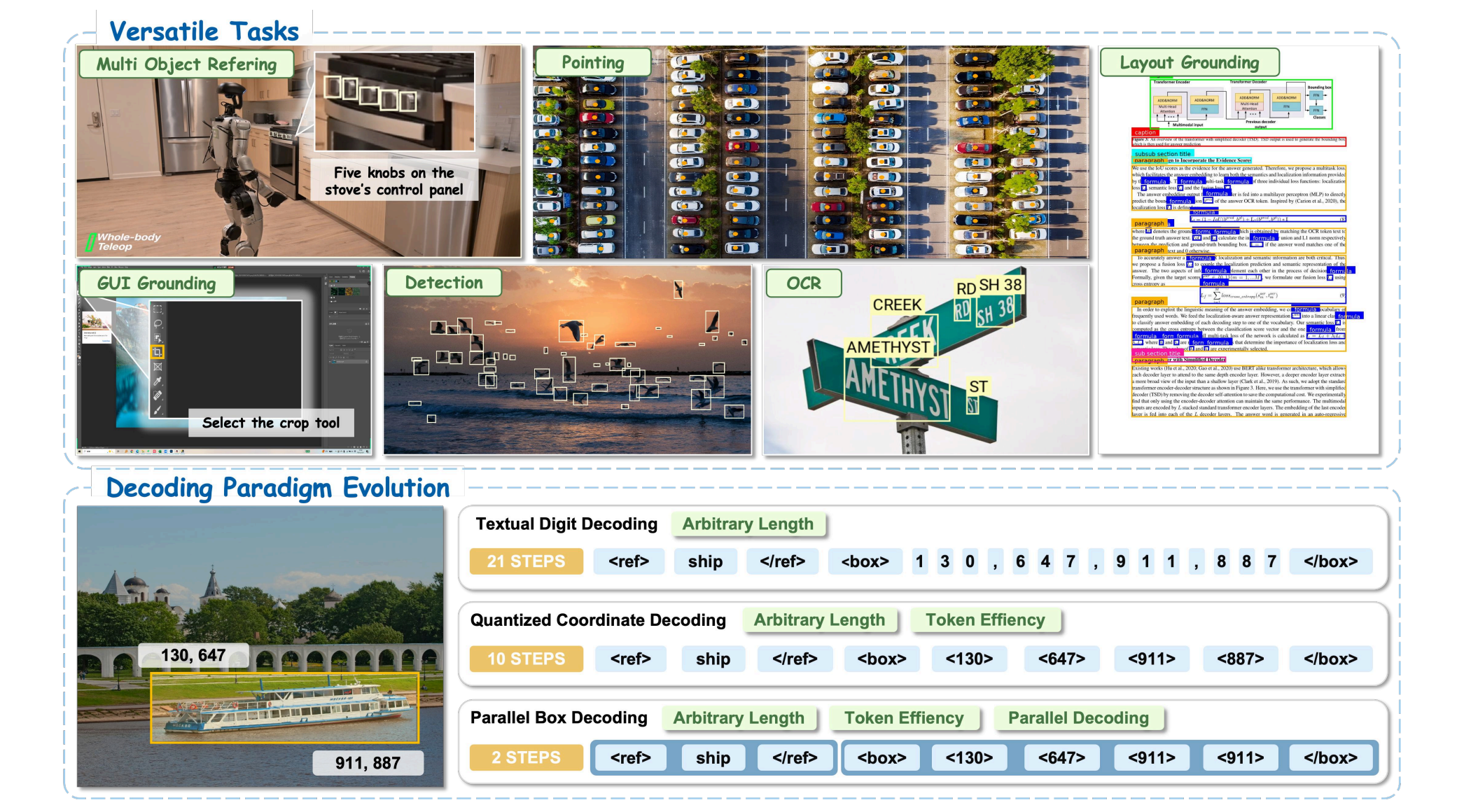
The standard method for predicting bounding boxes in traditional VLMs relies on autoregressive, token-by-token generation. Models like LLaVA or earlier Qwen-VL variants output coordinates sequentially. First the coordinate is generated, then , followed by , and finally . This sequential nature creates two massive bottlenecks.
- Latency penalty. Generating four separate tokens for every single bounding box drastically reduces throughput.
- Geometric hallucination. Early coordinate predictions heavily bias the subsequent generation of later coordinates. If the model slightly misses , the generation of is often completely thrown off, resulting in malformed bounding boxes.
LocateAnything-3B solves this with Parallel Box Decoding (PBD).
Instead of generating a sequence of text-based coordinates, the model formulates the output using a block-based structure. It predicts an entire bounding box as a single atomic unit (a fixed-length block) in one forward pass.
[!NOTE] Parallel Box Decoding enables coordinates to be processed simultaneously, ensuring that the model evaluates the geometric consistency of the entire box at once, rather than guessing point by point.
This mechanism fundamentally changes the computational graph during inference. The GPU does not have to wait for the first coordinate to finalize before computing the probabilities of the remaining three coordinates. They are solved in parallel, heavily optimizing GPU tensor core utilization.
Dual-Formulation Training
To achieve parallel box generation without destroying the model's core causal reasoning, NVIDIA uses a specialized dual-formulation training strategy. They construct a concatenated sequence of both Next-Token Prediction (NTP) and Multi-Token Prediction (MTP) targets.
By employing a highly specialized attention mask, the standard language streams use causal attention, while the MTP blocks utilize block-causal and bidirectional intra-block attention. This prevents data leakage and is supported by Stream Packing and MagiAttention to maximize GPU utilization on highly irregular sequences.
Execution Modes
LocateAnything-3B offers dynamic execution modes to balance throughput and spatial robustness.
Hybrid Mode
Fast Mode
Slow Mode
Batched Execution
[!WARNING] While Fast Mode is exceptional, falling back to Slow Mode causes latency to spike significantly. Developers building real-time autonomous agents must account for unpredictable worst-case latency in complex scenes.
LocateAnything-Data & The Grounding Data Engine
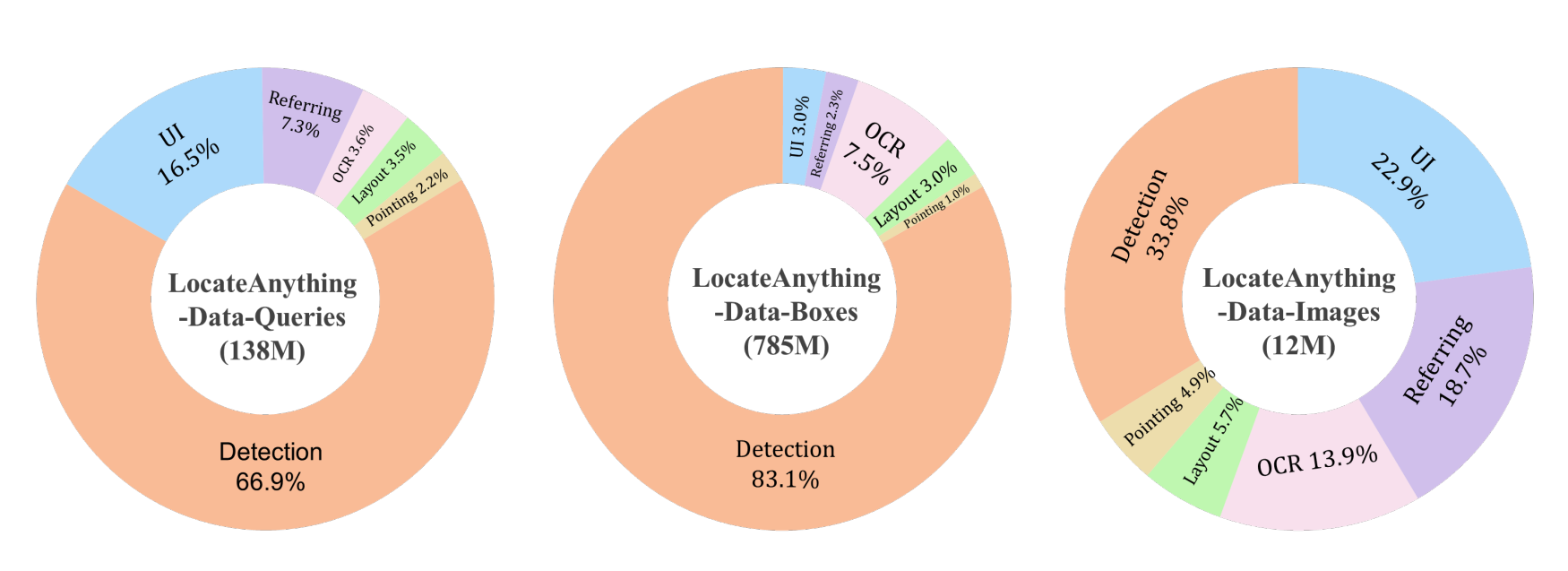
A model is only as good as its data. To push boundaries on precise localization, NVIDIA curated LocateAnything-Data, a massive multi-domain dataset containing 138 million queries and 785 million bounding boxes.
Because existing grounding datasets are limited, NVIDIA developed a Multi-Targets Grounding Data Engine that synthesizes annotations from unlabeled images:
- Query Generation: Qwen3-VL generates detailed object-centric queries from raw images.
- Point Grounding: Molmo takes these queries and predicts candidate coordinate points.
- Box Generation: SAM 3 processes these points to output tight bounding boxes, which are then post-verified by Qwen3-VL.
This automated pipeline vastly increased data diversity, enabling superior performance in long-tail and heavily packed scenarios.
Real-World Applications
The speed and precision of LocateAnything-3B unlock several applications that were previously impossible with bulky, slow VLMs. The sub-100ms latency profile changes the paradigm for autonomous systems.
Agentic UI Automation
Computer agents navigating web browsers or native applications require instantaneous feedback on screen elements. Previous models took several seconds to locate a "Submit" button, making automation painfully slow. LocateAnything-3B can parse a 1080p UI screenshot and return the coordinates of dozens of interactable elements in milliseconds. This enables agents to click and type at superhuman speeds.
Robotics and Navigation
Drones and robotic arms require real-time spatial awareness. A robotic arm sorting recycling on a conveyor belt cannot wait for an autoregressive sequence to finish generating. The Parallel Box Decoding outputs bounding boxes fast enough to maintain a 30 FPS control loop. This allows physical robots to track and intercept moving objects dynamically.
Autonomous Driving Diagnostics
While not designed to replace primary self-driving vision systems, LocateAnything-3B acts as an excellent diagnostic overlay. Engineers can query dashcam footage using natural language to extract specific edge cases. Queries like "Locate all traffic cones partially obscured by snow" return instant bounding boxes, drastically accelerating data labeling workflows for autonomous vehicle fleets.
Community Benchmarks
The AI community's reception of LocateAnything-3B has been highly positive. It achieves an impressive balance of a small parameter count and class-leading localization speed. Independent researchers have thoroughly vetted NVIDIA's claims.
- Throughput. On a single NVIDIA H100 GPU, the model achieves a throughput of 12.7 boxes per second in its default Hybrid mode (and up to 15.3 BPS in Fast mode).
- Speedup vs Baselines. It operates approximately 10x faster than textual models like Qwen3-VL and 2.5x faster than quantized-based models like Rex-Omni.
- GUI & Document Grounding. Reaches state-of-the-art 60.3 Avg Acc on ScreenSpot-Pro, and sets new standards on DocLayNet (76.8 F1) and M6Doc (70.1 F1) for document layout analysis.
- Dense Object Resilience. Scores an impressive 87.6 F1@Point on the Dense200 benchmark, proving exceptional resilience in heavily packed, overlapping visual environments.
- Edge Viability. At just 3 Billion parameters, the model easily fits into consumer GPUs (e.g., RTX 3060/4060) and edge devices like the Jetson Orin.
Practical Usage and Code Examples
LocateAnything-3B integrates cleanly into the standard Hugging Face transformers ecosystem. Below are practical examples of how to initialize the model and run an inference pass for visual grounding.
Standard Setup
Load the processor and the model with trust_remote_code=True. The model weights are natively formatted in bfloat16, which provides the best balance of precision and memory efficiency on modern hardware.
1from transformers import AutoProcessor, AutoModelForCausalLM
2from PIL import Image
3import torch
4
5# 1. Initialize Processor and Model
6model_id = "nvidia/LocateAnything-3B"
7processor = AutoProcessor.from_pretrained(
8    model_id,
9    trust_remote_code=True
10)
11model = AutoModelForCausalLM.from_pretrained(
12    model_id,
13    torch_dtype=torch.bfloat16,
14    device_map="auto",
15    trust_remote_code=True
16)
17
18# 2. Prepare the Image and Prompt
19image = Image.open("dashboard_screenshot.jpg")
20prompt = "<|image|>\nLocate the 'Submit' button in the interface."
21
22inputs = processor(
23    text=prompt,
24    images=image,
25    return_tensors="pt"
26).to("cuda", torch.bfloat16)
27
28# 3. Generate Bounding Boxes
29outputs = model.generate(
30    **inputs,
31    max_new_tokens=128
32)
33
34# 4. Decode the Coordinate Output
35decoded_output = processor.decode(outputs[0], skip_special_tokens=True)
36print(decoded_output)
37# Expected Output format: [x1, y1, x2, y2]
Advanced Batched Inference
For high-throughput server environments, processing images one by one leaves GPU compute units idle. You can batch multiple images and prompts together. This requires padding the visual tokens properly.
1# Assuming 'images' is a list of PIL Images and 'prompts' is a list of strings
2inputs = processor(
3    text=prompts,
4    images=images,
5    return_tensors="pt",
6    padding=True
7).to("cuda", torch.bfloat16)
8
9# Generate bounding boxes for the entire batch simultaneously
10outputs = model.generate(
11    **inputs,
12    max_new_tokens=128
13)
14
15# Decode outputs in a loop
16for i, out in enumerate(outputs):
17    decoded = processor.decode(out, skip_special_tokens=True)
18    print(f"Batch Item {i} Result: {decoded}")
Community Ports
The open-source community is actively porting the model for broader edge deployment, including experimental locate-anything.cpp and CoreML variants for Apple Silicon. Official TensorRT-LLM support from NVIDIA is anticipated in future releases.
Limitations and Future Work
While LocateAnything-3B is a massive leap forward, it is not without limitations. The 3B parameter count constraints its general knowledge. It cannot answer complex factual questions about the image like larger 72B parameter models can. Its singular focus is localization.
Furthermore, the model struggles with extreme occlusion. If an object is more than 90% hidden behind another object, the MoonViT encoder sometimes fails to isolate the necessary spatial features. NVIDIA researchers have hinted that future versions will incorporate temporal tracking to resolve occlusions over video frames.
Model Fine-Tuning and Adaptation
For specialized industrial use cases, the base LocateAnything-3B model can be fine-tuned using standard techniques like Low-Rank Adaptation (LoRA). Because the architecture relies on the standard Qwen2.5-3B backbone, you can freeze the MoonViT encoder and exclusively train the language reasoning head on domain-specific datasets.
This is incredibly useful in sectors like medical imaging or highly specific manufacturing QA. If you need the model to locate microscopic fractures on a circuit board, a few hundred annotated examples will rapidly adapt the model's spatial reasoning to that specific visual domain. The training process requires very little compute, and most LoRA adaptations can be completed on a single consumer GPU within hours.
Final Thoughts
NVIDIA LocateAnything-3B represents a significant shift in how Vision-Language Models handle spatial data. By moving away from autoregressive token generation for coordinates and embracing Parallel Box Decoding, it achieves a massive leap in speed without compromising accuracy. For developers building Agentic UI automation, robotics systems, or real-time object tracking, this 3B parameter model offers a highly capable, edge-ready solution. It proves that architectural innovation often beats raw parameter scaling.
References
Previous Post
GLM-5.2 Deep Dive: Z.ai's 744B MoE Model with 1M Context Window
Next Post
CadCore: Autonomous Agentic CAD Engine with Closed-Loop Self-Healing
If the article helped you in some way, consider giving it a like. This will mean a lot to me. You can download the code related to the post using the download button below.
If you see any bug, have a question for me, or would like to provide feedback, please drop a comment below.