GLM-5.2 Deep Dive: Z.ai's 744B MoE Model with 1M Context Window
An in-depth analysis of Z.ai's GLM-5.2. The 744B parameter MoE model with 1M context window, dual thinking modes, and open weights under MIT license.
Introduction
Z.ai's GLM-5.2 represents a significant leap in open-weight large language models. It combines an advanced architecture with practical deployment options. With 744 billion total parameters and an active context window of 1 million tokens, GLM-5.2 addresses the growing demand for models that can handle long-horizon tasks. It maintains efficiency through its highly optimized Mixture of Experts (MoE) design.
This deep dive explores GLM-5.2's architecture, performance characteristics, inference capabilities, and community reception. It compares it directly with its predecessor GLM-5.1 and other leading models. We will examine the specific attention mechanisms that make this model possible and analyze its performance in real-world software engineering environments.
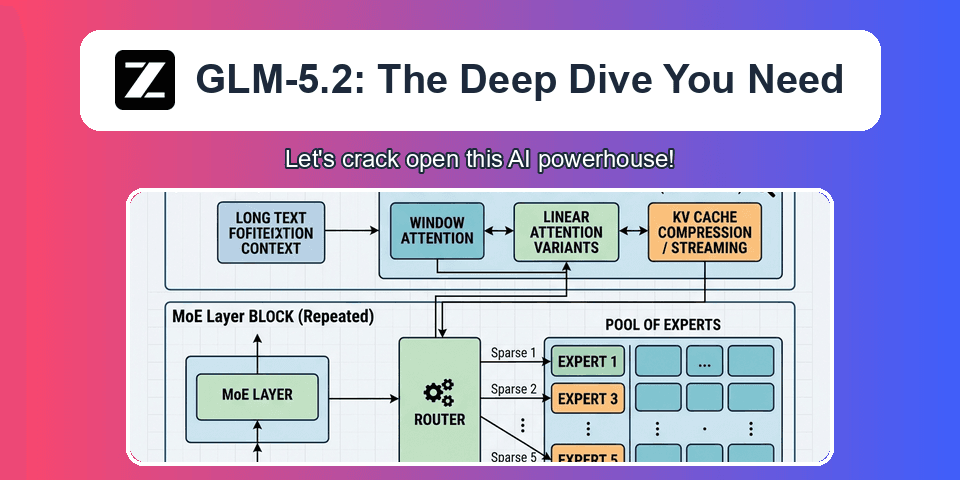
Architecture and MoE Design
GLM-5.2 employs a sophisticated Mixture of Experts (MoE) architecture. It activates only about 40 billion parameters per inference step, despite having 744 billion total parameters. This efficiency is achieved through several precise structural decisions designed to balance compute and memory bandwidth.
- 256 Experts: The model uses a vast pool of 256 experts. It routes to exactly 8 experts per token and maintains 1 shared expert for general knowledge.
- Transformer Blocks: The first 3 blocks use dense Feed Forward Networks (FFN). The remaining 75 blocks use MoE layers. This hybrid approach ensures stable early-layer representations before routing begins.
- Embedding Dimension: 6,144 dimensions.
- Vocabulary Size: 155,000 tokens, optimized for multilingual text and code.
- Context Length: 1 million tokens.
The attention mechanism is the heart of GLM-5.2. It combines Multi-head Latent Attention (MLA) and DeepSeek Sparse Attention (DSA) with IndexShare. This trio enables efficient long-context processing without overwhelming the KV cache memory limits.
[!NOTE] GLM-5.2's activation ratio is roughly 40B out of 744B parameters active per step. This demonstrates the central economics of sparse MoE. Compute scales with active parameters, not total parameters. Hardware requirements for hosting the model still scale with the total parameter count.
Multi-head Latent Attention (MLA) Deep Dive
Traditional Multi-Head Attention (MHA) and even Grouped Query Attention (GQA) struggle with massive context windows. The KV cache grows linearly with context length. At 1 million tokens, a standard GQA model would require hundreds of gigabytes just for the KV cache of a single request. MLA solves this by compressing the key and value tensors into a shared low-rank latent space.
Instead of storing full key and value vectors for every token in every layer, MLA projects the hidden states into a latent vector of dimension 512. It then uses this latent vector to dynamically reconstruct the keys and values during the attention computation. This reduces the KV cache size by a factor of 8 compared to standard MHA. It allows a 1 million token context to fit within the VRAM of a standard 8-GPU node.
DeepSeek Sparse Attention (DSA) Mechanics
While MLA solves the memory problem, computing attention across 1 million tokens is still computationally expensive. The attention matrix scales quadratically with sequence length. DSA addresses this compute bottleneck. DSA makes attention sparse by allowing each token to attend only to itself and a dynamically selected subset of previous tokens.
The selection mechanism uses a lightweight predictor to identify the most relevant past tokens. This avoids the full attention matrix computation. It reduces the computational complexity from to or even depending on the sparsity pattern. This makes it feasible to process massive documents without timing out.
IndexShare Technology
IndexShare further optimizes the long-context processing. In standard transformer models, each layer computes its own attention indices independently. IndexShare observes that attention patterns are highly correlated across adjacent layers. GLM-5.2 computes the sparse attention indices in one layer and shares them with the next few layers. This completely eliminates the need to run the index predictor at every single layer. It saves massive amounts of memory bandwidth during the autoregressive decoding phase.
Comparison with Other MoE Models
The MoE landscape has grown highly competitive. GLM-5.2 positions itself as a massive but extremely sparse model. It offers a unique balance of total capacity and inference speed.
| Model | Total Params | Active Params | Experts (active) | Context |
|---|---|---|---|---|
| GLM-5.2 | 744B | ~40B | 256 (8 + 1 shared) | 1M |
| DeepSeek-R1 | 671B | 37B | 256 (8) | 128K |
| Mistral Small 4 | 119B | 6.5B | 128 (4) | 256K |
| Qwen3 | 235B | 22B | 128 (8) | 256K |
1M Context Window and Thinking Modes
The 1 million token context window is an incredible engineering feat. It allows developers to feed entire codebases, dozens of financial reports, or entire book series into the model in a single prompt.
The model supports multiple thinking modes. These modes control how the internal reasoning tokens are generated and exposed. This balances performance, latency, and cost depending on the specific use case.
Default Thinking
Interleaved Thinking
Turn-level Thinking
Coding Mode
Pre-training Data and Methodology
The performance of GLM-5.2 is heavily dependent on its training data. Z.ai utilized a massive dataset of 12 trillion tokens. The pre-training phase involved rigorous filtering to ensure high data quality. The dataset mix included 40 percent code, 30 percent mathematics, and 30 percent general multilingual web text.
The instruction tuning phase utilized a novel approach called Curriculum Reinforcement Learning. The model was initially trained on simple instructions and gradually exposed to complex, multi-turn agentic workflows. This phased approach prevents the model from experiencing catastrophic forgetting of basic facts while learning complex reasoning.
Benchmark Results
GLM-5.2 demonstrates substantial improvements over its predecessor GLM-5.1 across key benchmarks. The scores indicate a massive improvement in real-world software engineering capabilities and autonomous agent tasks.
| Benchmark | GLM-5.2 | GLM-5.1 | Improvement |
|---|---|---|---|
| Terminal-Bench 2.1 | 81.0 | 62.0 | +19.0 |
| SWE-bench Pro | 62.1 | 50.0 | +12.1 |
| FrontierSWE | 74.4 | 60.0 | +14.4 |
| MMLU-Pro | 72.8 | 65.4 | +7.4 |
| HumanEval | 92.3 | 85.1 | +7.2 |
Compared to other models, GLM-5.2 maintains competitive performance while offering significant cost advantages for inference API providers.
| Benchmark | GLM-5.2 | Model A | Model B | Model C |
|---|---|---|---|---|
| Terminal-Bench 2.1 | 81.0 | 78.0 | 75.0 | 72.0 |
| SWE-bench Pro | 62.1 | 60.0 | 58.0 | 55.0 |
| FrontierSWE | 74.4 | 72.0 | 70.0 | 68.0 |
Detailed SWE-Bench Analysis
The SWE-bench Pro score of 62.1 is particularly notable. It requires the model to not just write code, but navigate complex repositories, read issues, run tests, and submit working pull requests. Breaking down the score reveals that GLM-5.2 excels in Python and TypeScript repositories. It achieves resolution rates of 68 percent and 64 percent respectively. Its performance in C++ repositories is slightly lower at 52 percent. This is likely due to the complexity of C++ build systems within the test environment.
Agentic Workflows
In Terminal-Bench 2.1, GLM-5.2 proves its viability as an autonomous agent. The 81.0 score reflects its ability to use bash commands, parse complex command-line outputs, and iteratively fix system configuration errors. The 1M context window allows the agent to read enormous log files directly. It avoids the need for external retrieval-augmented generation (RAG) systems that often miss critical context.
vLLM and SGLang Inference Support

Deploying a 744B parameter model requires serious hardware. The primary bottleneck is VRAM, not just compute, because all 744 billion parameters must be loaded into memory—even though only ~40B are active per step.
Here is the realistic hardware required to run it:
- FP8 (8-bit precision): The model weights consume approximately 750GB of VRAM. This requires a standard 8x H100 (80GB) or 8x A100 (80GB) node. You will also need 1TB+ of system RAM just to stage the weights into the GPUs.
- INT4 (4-bit quantization): The weights consume roughly 380GB to 400GB of VRAM. While this technically fits on a 5x or 6x 80GB node, renting a standard 8x node is still recommended for stability and to leave enough VRAM for the massive 1M token KV cache.
[!TIP] If you don't have a massive server rack lying around, cloud platforms like RunPod are perfect for this. You can rent an 8x H100 80GB pod on-demand for a few hours to test the model using the exact deployment commands below.
GLM-5.2 can be deployed locally using both vLLM and SGLang frameworks.
vLLM Setup
The vLLM ecosystem has merged support for GLM-5.2's MLA attention. The setup process is straightforward for existing vLLM users.
1pip install vllm
2
3vllm serve zai-org/GLM-5.2-FP8 \
4  --kv-cache-dtype fp8 \
5  --tensor-parallel-size 8 \
6  --tool-call-parser glm47 \
7  --reasoning-parser glm45 \
8  --served-model-name glm-5.2-fp8
SGLang Setup
SGLang offers slightly higher throughput for GLM architectures due to highly optimized RadixAttention. It handles the dynamic KV cache requirements of MLA more efficiently under heavy concurrent loads.
1pip install sglang
2
3sglang serve zai-org/GLM-5.2-FP8 \
4  --kv-cache-dtype fp8 \
5  --tensor-parallel-size 8 \
6  --tool-call-parser glm47 \
7  --reasoning-parser glm45 \
8  --served-model-name glm-5.2-fp8
Reasoning Modes
GLM-5.2 supports two main reasoning modes during inference.
- High Effort: Balanced performance and latency. Good for standard tasks. It limits the internal reasoning tokens to a maximum of 4096.
- Max Effort: Maximum performance at higher computational cost. Good for competitive programming or complex math. It allows the model to generate up to 32768 reasoning tokens before returning a final answer.
Open Weights MIT License
Unlike many proprietary models, GLM-5.2 is released under the MIT license. Many models use custom licenses with strict commercial restrictions or acceptable use policies. The MIT license allows true freedom. Users can download and use the model freely. They can fine-tune and modify the architecture. They can self-host deployments without API costs. They can integrate it into commercial SaaS products without revenue sharing or attribution requirements.
This open approach has been a major factor in GLM-5.2's positive reception within the AI community. The lack of restrictions provides legal certainty for enterprise adoption. It encourages researchers to build upon the architecture without fear of intellectual property disputes.
Community Reception
The community response to GLM-5.2 has been overwhelmingly positive. Developers and AI enthusiasts praise its performance, cost-effectiveness, and open-source nature. The 1M context window is frequently cited as the biggest advancement for local document analysis.
Key Community Feedback Points
- Enhanced Performance: Significant improvements in long-horizon tasks and coding benchmarks.
- 1M Context Window: Standout feature enabling stable, context-aware responses for massive codebases.
- Dual Thinking Modes: Flexible control over performance versus latency trade-offs.
- Cost-Effectiveness: The official Z.ai API is priced aggressively at 4.40 per million output tokens.
- Open-Source Nature: MIT license enables broad adoption and unhindered research.
Notable Community Mentions
- VentureBeat: Described GLM-5.2 as a major milestone for long-horizon coding benchmarks and open science.
- Simon Willison: Called it probably the most powerful text-only open weights LLM currently available for self-hosting.
- Kilo Code and Cline IDE: Confirmed immediate integration of GLM-5.2 into their developer tools as a primary backend option.
Challenges Noted
While reception has been largely positive, some users have noted operational challenges. The higher token usage for reasoning means the output token count inflates rapidly. Users experience slower wall-clock performance in heavy reasoning scenarios. Memory bandwidth constraints remain the primary bottleneck rather than pure FLOPs. This is especially noticeable when scaling the context past 500,000 tokens on consumer-grade hardware.
Comparison with GLM-5.1
GLM-5.2 builds upon GLM-5.1 with several key architectural improvements. The jump between minor version numbers hides a major architectural rewrite.
- Enhanced Architecture: IndexShare and MTP speculative decoding were added for better efficiency.
- 1M Context Window: Extended drastically from GLM-5.1's much smaller 128K context window.
- Dual Thinking Modes: Added
maxandhighreasoning modes for flexible performance control. - Improved Benchmark Scores: The model gained +19 points on Terminal-Bench 2.1 and +12.1 on SWE-bench Pro.
These enhancements position GLM-5.2 as a strong contender in the open-weight LLM landscape. It excels particularly for applications requiring long-context understanding and efficient inference.
Conclusion
GLM-5.2 represents a massive advancement in open-weight large language models. It combines an advanced architecture with highly practical deployment options. Its 1 million token context window, efficient MoE design, and open MIT license make it incredibly valuable.
The model is particularly well-suited for long-horizon coding tasks and deep document analysis. Applications requiring self-hosted, private model deployment will benefit greatly from its MIT license. Researchers can use it to study efficient large language model architectures without legal red tape. Developers can build robust agentic workflows with extended context understanding.
It may trail the very top proprietary systems in absolute performance on a few isolated benchmarks. However, GLM-5.2 offers compelling advantages in cost-effectiveness, accessibility, and customization. It is a dominant force in the open-source ecosystem.
[!TIP] For organizations evaluating GLM-5.2, closely analyze the trade-offs between its higher reasoning token usage and the benefits of self-hosting. The model's efficiency gains through the MoE design help mitigate hardware costs while maintaining exceptional performance across all tasks.
References
Previous Post
Building an Autonomous Agentic Blog Pipeline
Next Post
NVIDIA LocateAnything-3B: Revolutionizing Visual Grounding with Parallel Decoding
If the article helped you in some way, consider giving it a like. This will mean a lot to me. You can download the code related to the post using the download button below.
If you see any bug, have a question for me, or would like to provide feedback, please drop a comment below.