The OpenBMB Ecosystem: A Master Guide to MiniCPM and Beyond
A complete guide to the OpenBMB model ecosystem, including MiniCPM, Eurus, and their edge-computing efficiency.
OpenBMB (Open Lab for Big Model Base) is reshaping the AI landscape by proving that massive parameter counts are not the only path forward. Their focus is clear: build highly efficient, standard-setting AI models that run exceptionally well on edge devices and consumer GPUs.
Here is the master breakdown of the OpenBMB ecosystem, exploring their history, salient features, and the complete lineup of their models.
1. Company History & Mission
OpenBMB was co-founded by the Natural Language Processing Laboratory of Tsinghua University (THUNLP) and ModelBest Inc.
Their primary mission is to democratize large language models. Instead of relying exclusively on massive cloud clusters, OpenBMB engineers foundational models and toolkits (like BMTrain and BMInf) designed to run locally, efficiently, and with minimal hardware requirements.
[!NOTE] The team behind OpenBMB has deep roots in academic NLP research, notably contributing to the foundational ERNIE language representation model.
2. Salient Features: Why OpenBMB Stands Out
OpenBMB models, particularly the MiniCPM series, stand out for three core reasons:
- Edge Computing Superiority: They are specifically engineered for smartphones and consumer hardware.
- Extreme Parameter Efficiency: A 2B or 4B parameter OpenBMB model consistently rivals the performance of 7B to 13B models from other organizations.
- Hybrid Architectures: Innovations like sparse attention (NOSA) allow these models to process massive context windows (up to 1M tokens) without crashing standard GPUs.
3. The Master List of Models
The OpenBMB ecosystem is divided into specific model families based on their architecture and use-case.
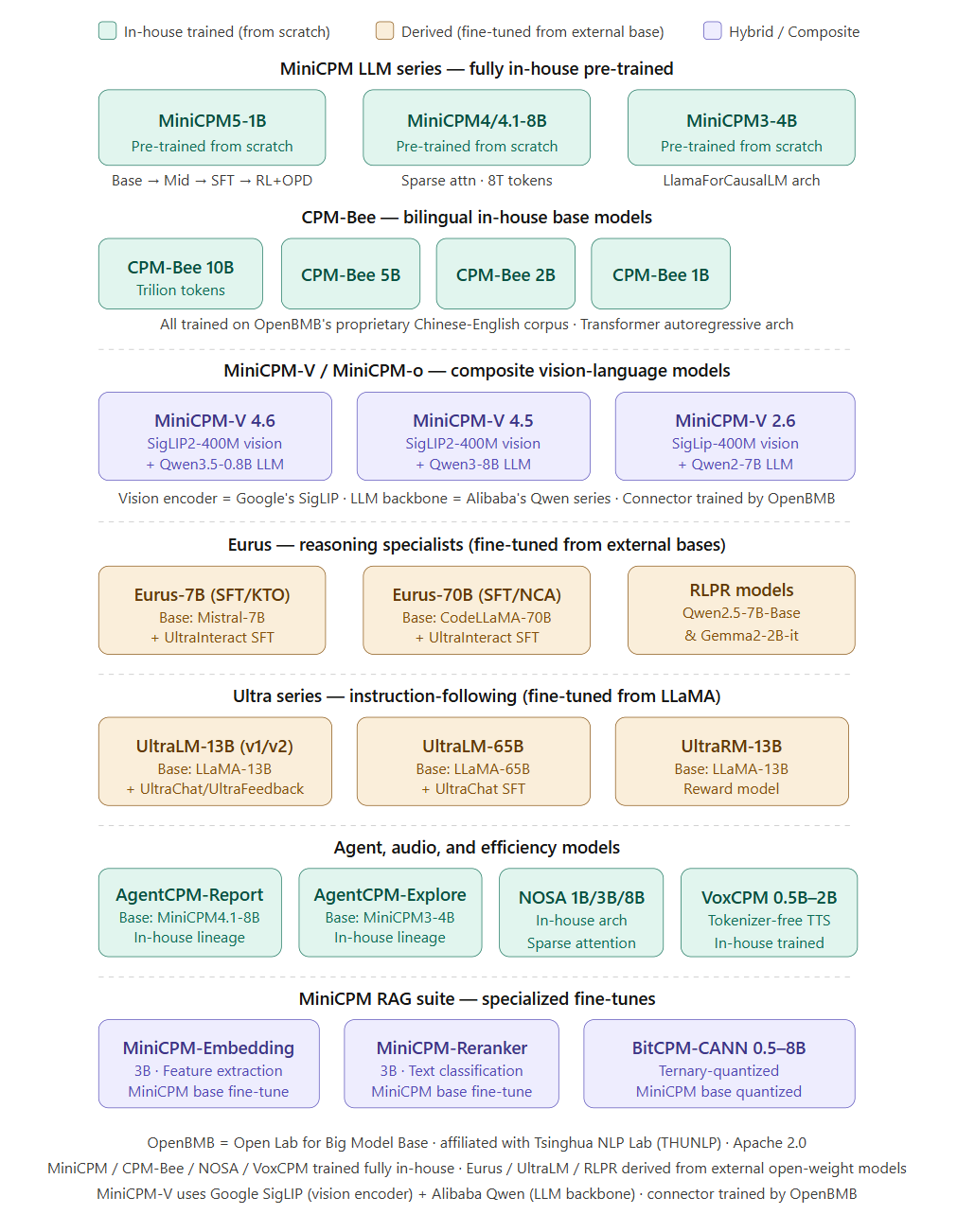
MiniCPM Series (Fully In-House Pre-Trained)
The flagship "pocket-sized" models built from scratch for maximum efficiency.
| Model | Parameters | Explanation |
|---|---|---|
| MiniCPM5-1B | 1B | Pre-trained from scratch. Ideal for extreme low-memory edge devices. |
| MiniCPM4/4.1-8B | 8B | Employs sparse attention to handle massive 8T token contexts efficiently. |
| MiniCPM3-4B | 4B | Uses the LlamaForCausalLM architecture. High performance at a mid-tier size. |
CPM-Bee (Bilingual Base Models)
These models are trained entirely on OpenBMB's proprietary Chinese-English corpus using a standard Transformer autoregressive architecture. They range heavily in size.
- CPM-Bee 10B (Trillion token training)
- CPM-Bee 5B
- CPM-Bee 2B
- CPM-Bee 1B
MiniCPM-V / MiniCPM-o (Composite Vision-Language Models)
These multimodal models combine external vision encoders with robust LLM backbones via an OpenBMB-trained connector.
| Model | Vision Encoder | LLM Backbone |
|---|---|---|
| MiniCPM-V 4.6 | Google SigLIP2-400M | Alibaba Qwen3.5-0.8B |
| MiniCPM-V 4.5 | Google SigLIP2-400M | Alibaba Qwen3-8B |
| MiniCPM-V 2.6 | Google SigLIP-400M | Alibaba Qwen2-7B |
[!TIP] Use MiniCPM-V for on-device image and high-FPS video understanding on mobile phones.
Eurus (Reasoning Specialists)
Fine-tuned from open-weight base models specifically for logic and reasoning tasks using UltraInteract SFT.
- Eurus-7B: Base Mistral-7B (SFT/KTO)
- Eurus-70B: Base CodeLLaMA-70B (SFT/NCA)
- RLPR Models: Based on Qwen2.5-7B and Gemma2-2B-it.
Ultra Series (Instruction-Following)
Fine-tuned versions of LLaMA designed strictly for instruction following and conversational alignment using UltraChat and UltraFeedback.
- UltraLM-13B (v1/v2)
- UltraLM-65B
- UltraRM-13B (Reward Model)
Agent, Audio, and Efficiency Models
Specialized tools built upon the MiniCPM lineage.
| Model | Functionality | Architecture |
|---|---|---|
| AgentCPM-Report | Agent execution | MiniCPM4.1-8B base |
| AgentCPM-Explore | Agent execution | MiniCPM3-4B base |
| NOSA (1B/3B/8B) | Highly efficient long-context | In-house Sparse Attention |
| VoxCPM (0.5B-2B) | Tokenizer-free TTS | In-house trained |
MiniCPM RAG Suite (Specialized Fine-Tunes)
Purpose-built for Retrieval-Augmented Generation (RAG) pipelines.
- MiniCPM-Embedding (3B): Feature extraction fine-tuned from MiniCPM.
- MiniCPM-Reranker (3B): Text classification fine-tuned from MiniCPM.
- BitCPM-CANN (0.5-8B): Ternary-quantized models for extreme efficiency.
4. Community Sentiment & Known Challenges
The broader developer community (particularly on GitHub and r/LocalLLaMA) holds OpenBMB in high regard for its unmatched performance-to-size ratio. The MiniCPM series is frequently praised for executing complex OCR and structured output tasks locally on consumer hardware.
However, early adopters should be aware of a few known friction points:
- Deployment Hurdles: Setting up the environment can be complex. Developers frequently encounter dependency conflicts when integrating with mainstream inference backends like
vLLMorOllama, often necessitating community workarounds or "CookBooks" until official support catches up. - Hardware-Specific Crashes: When processing long-context multimodal inputs (like high-FPS video), users on lower-end hardware (4GB–8GB VRAM) occasionally report memory spike crashes.
- Grounding Accuracy: While vision tasks are strong, some developers report that specific spatial grounding or "thinking" modes can occasionally degrade performance on highly structured tasks.
[!WARNING] Before deploying MiniCPM in production, always check the OpenBMB GitHub Issues tab. Due to the rapid release cycle, the community frequently relies on patched forks for immediate bug fixes.
Conclusion
OpenBMB is demonstrating that the future of AI isn't just about building larger clusters, but about making dense, capable models accessible to everyone. By focusing on edge computing and hybrid architectures, the MiniCPM ecosystem puts state-of-the-art capability directly into your pocket.
Related Posts
- Self-Hosting LLMs: vLLM, SGLang, and Llama.cpp
- Small, Powerful Core: The Rise of Small LLMs and VLMs
References
Previous Post
Building a Unified 3D Printer Control and AI Monitoring Dashboard with Gradio and Printcore
Next Post
LiquidAI Foundation Models (LFMs): A Master Guide to Efficiency by Design
If the article helped you in some way, consider giving it a like. This will mean a lot to me. You can download the code related to the post using the download button below.
If you see any bug, have a question for me, or would like to provide feedback, please drop a comment below.